Technology empowering human services


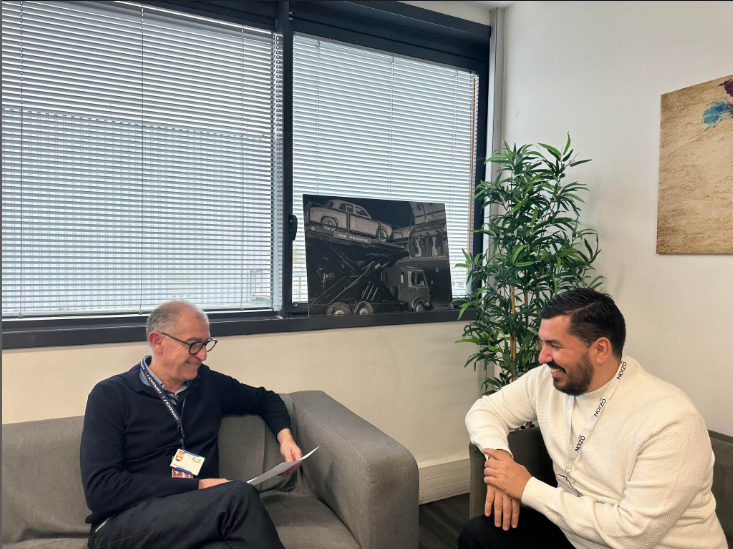
Xavier Bryche, Head of Security at Air France Cargo, speaks with Daniel Moreno about more than fifteen years of working with Ozion at the Roissy cargo site: the electronic logbook, patrol traceability, accompanied access permits and continuity when security providers change.
Abridged interview translated from the original French transcript. Repetitions and some digressions have been removed, with minor adjustments for readability.
Daniel Moreno:
In what context did this collaboration begin?
Xavier Bryche:
I was not yet in this role when the partnership began. It was Pascal who, through a security services contract we had with Samsic, now called SafeSquare, brought about the collaboration with you.
The idea, I believe, was to develop features that did not yet exist, particularly to record the application of certain security measures at the Air France Cargo site electronically, and also to set up an electronic logbook to report and track security and safety events.
I have been in this role here since 2010. Over the years, we have shared a great many ideas: some were implemented, others put on hold, and new priorities emerged. But in a field as regulated as civil aviation security, innovation remains essential.
It is a very human profession, with a lot of work on the ground. And if we do not give officers tools suited both to the regulations and to the industrial environment in which they work, it is complicated.
I did not want to start from scratch every time we changed security providers. That is why, today, we are almost entirely independent. When we change providers, the equipment is already in place, as are the information systems. As a result, bringing in a new company, a new contract, is much easier.
In practical terms, everything is operational within a few hours. Officers know what they have to do, and the tools are already deployed.
Keeping the same systems provides continuity and real working comfort. We do not start from scratch with a new provider.
Daniel Moreno:
How do aviation regulations make the job so demanding?
Xavier Bryche:
Today, we apply a European regulation, which is then supplemented by texts specific to each Member State: ministerial and interministerial orders, alongside the Civil Aviation Code, the Transport Code and the prefectural orders in force at each airport.
Here, at the Air France Cargo site, we have to implement seven of the twelve areas of the European regulation. That is a substantial amount, and therefore complex, given all the measures we have to juggle when putting it into practice.
Having tools that manage the rules, check the rules and help security officers implement the measures also helps ensure a degree of stability in how we manage them. We are inspected regularly by the competent authorities, and when you are Air France, it is almost daily.
Daniel Moreno:
How did this relationship of trust and co-development with Ozion and the EVA solution develop?
Xavier Bryche:
To work on a tool like this, of course, you need a relationship of trust with your supplier.
I also work on the principle that, as in any partnership, there can be successes and failures. We also learn from failures to correct ourselves, in life as in our professional lives.
If things are generally going well with a partner, there is no reason to change just for the sake of changing. Unless, of course, there have been significant changes in the people involved, because stability in the commercial and human relationship is very important. That is something valuable. It is not always present in every company.
That is something you have managed to provide at Ozion over the years: maintaining the connection with the client, even when there was not necessarily much development taking place. There were quieter periods, and then, in recent years, needs have accelerated, to improve officers’ working comfort while also providing greater rigor and the traceability expected in our civil aviation security profession.
Daniel Moreno:
Could you tell us about some significant developments or projects we have worked on together?
Xavier Bryche:
To build everything we have added in recent years, we needed a foundation. That foundation was, of course, the logbook and event traceability.
Then, over time, we added what was most important for us to achieve first: patrol traceability, whether related to a site’s fire safety, the integrity of the premises from a security perspective, or checks on people inside our site whom we also have to check. That is part of the measures.
We saw this recently with the number of visits allowed per person without a permanent airport access permit. The module for issuing accompanied airside access permits is indeed a major development for us.
Today, it is a great source of pride to have successfully developed all these features, which fully meet the regulations and which we can configure according to regulatory changes, prefectural or ministerial orders that tighten or relax certain regulatory provisions.
Daniel Moreno:
How has EVA contributed to operational performance, working comfort and the teams’ operational peace of mind?
Xavier Bryche:
All the modules we have had developed allow us today to stop worrying about the fundamentals of regulatory measures and to go a little further.
I am not going to say ‘towards perfection’, because we never reach it, but they do allow us to focus more on human weaknesses. Today, the tool has allowed us to stabilize the fundamentals of regulatory control—of course, within the scope of everything we have had developed through the tool.
There are still many things that remain manual or are handled by people, without necessarily being able to have a tool behind them. But for things that were very complex, today, we no longer have to worry about them.
When we have checks by the authorities, audits or inspections—whether unannounced or scheduled—we no longer have the same concerns as before, because we know the fundamentals are under control. That allows us to focus more on people: preparing people for a visit, an inspection or a scheduled audit. And that is comfortable for everyone: for us, the commissioning organization, the client, but also for our service provider and partner.
Of course, we contract a service with them, but we already provide them and their employees, their colleagues, with working comfort. It also helps retain and stabilize frontline teams, because they know that here, there is technology, innovation and consideration for their mission—and sometimes their task, which is not always easy.
By providing that working comfort, it ultimately brings the teams together too. It brings many things, but the most important, of course, is people. And that makes it easier for us to focus.
Daniel Moreno:
How do you see the future of digitalization and the management of security operations?
Xavier Bryche:
Information systems have their limits. Now, with the arrival of AI, we really do not know how far it will take us. In security, I believe people will retain responsibility for a significant proportion of the measures to be implemented.
In an industrial environment, I think tools like yours will always be able to find their place and provide solutions that security equipment cannot. After all, that equipment is there to inspect and screen people, baggage and cargo.
Of course, that equipment will increasingly be equipped with artificial intelligence. But in cargo, I believe there will always be a significant amount of human intervention. And that is precisely where you have a role to play: you can provide modeling capabilities and features that do not yet exist and will be developed.
The regulations tell us what our obligations are, but they do not tell us how we should meet them. It is up to us to innovate and find solutions. If they are electronic, prevent errors, simplify things and ease the burden on people, then that is a plus. And in that way, we both benefit.
Daniel Moreno:
How would you encourage your fellow security managers to consider these technologies?
Xavier Bryche:
Through discussions with my colleagues, we share a great deal of our security culture and experience: what we have each developed to address a particular problem, and discovering tools.
Without revealing everything, we can sometimes point colleagues towards considering a particular solution. We can also present a tool without revealing the details of the measures and rules.
Everything we can manage through tools and the development of those tools and interfaces—and I am only talking about what we have developed together—allows us to move faster on other developments, ahead of others, and therefore to be more competitive, more economical and to demonstrate our capabilities.
“When I talk about a partner, I do not mean a service provider. In this field, we can only succeed through a relationship of trust and continual collaboration.”
That is where loyalty and ongoing work come from—of course, when things are going well and development is regular. It is much easier when your supplier knows their client and the fundamentals of their profession well, rather than having to go through another company each time.
Daniel Moreno:
What do you take away from this human and technological journey?
Xavier Bryche:
First, it is this wonderful human journey, because having a solid professional relationship is becoming increasingly rare. But I think it depends a great deal on the people and on how those involved see the ongoing relationship with the client.
What I take away is, of course, your attentiveness and your ability to be patient while we think things through, because it is not always easy, given the complexity of the needs we express.
Building things—and building does not happen in two, three or four years.
All the projects under way to redevelop the cargo terminal and plan its future at Roissy for Air France over five or ten years also mean anticipating how we will need to approach and integrate security into those projects.
There is not a single project in which security is not involved. It is extremely stimulating and enriching, and of course it has generated many ideas. It helps us think about what we can develop together next.
It was, I think, a good opportunity for us—and certainly for me—to have met you through my predecessor, to have been able to build and continue this journey, and to develop everything we have built together so far.
Would you like to discuss your site’s security and traceability needs? Fill out the form below to contact the Ozion team.